
How to Design Cable Entries for Waterproof Electrical Enclosures
Cable-entry design is an important part of a waterproof
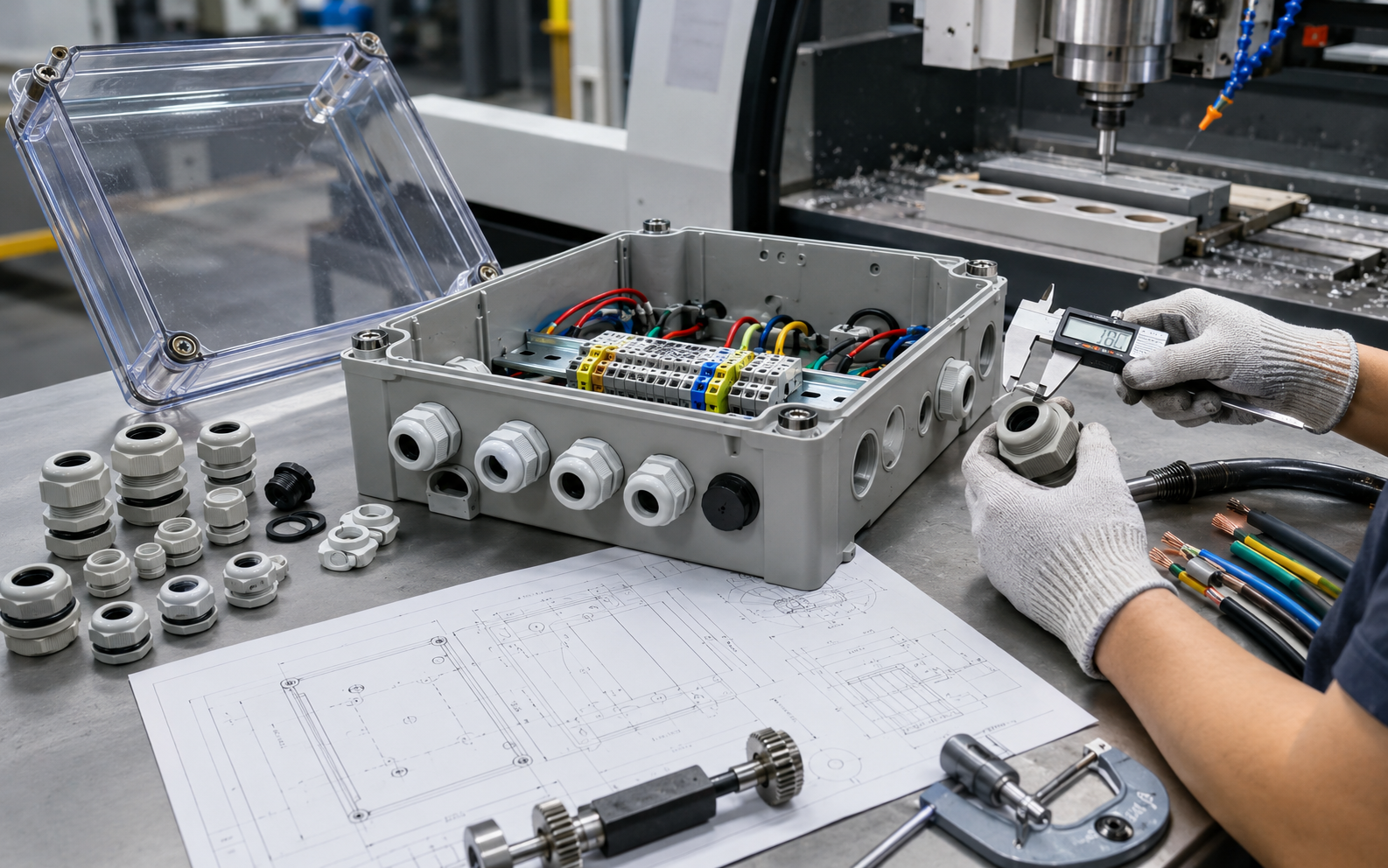
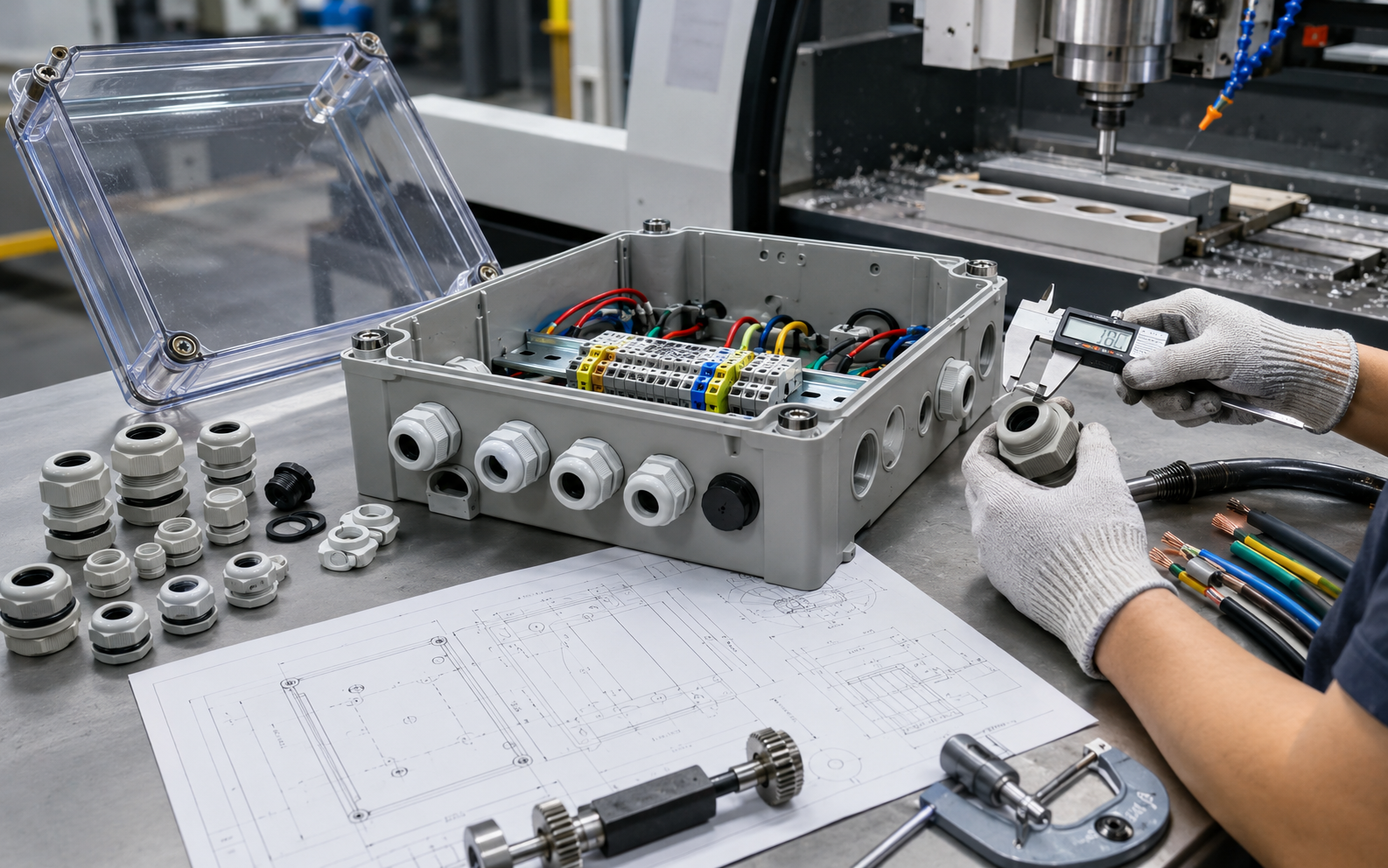
Article overview
Why Cable-Entry Design Matters
Cable-entry design is an important part of a waterproof electrical enclosure.
Incorrect hole sizes, unsuitable cable glands or poor entry positions can reduce
sealing performance and make installation difficult.
Before ordering a customized enclosure, buyers should confirm the cable diameter,
gland size, entry direction, internal components and required hole positions.
This guide explains the main points to check before CNC machining.
Every opening added to an enclosure may become a possible path for water or dust.
The enclosure, cable glands, sealing plugs and installation method must work together
as one complete system.
Common problems include:
- Holes that are too large or too small
- Cable glands that do not match the cable diameter
- Entries positioned too close to the enclosure edge
- Insufficient space between adjacent cable glands
- Unused holes without sealing plugs
- Cables blocking internal components
Buyers can review BOWO Electric's
waterproof electrical enclosure range
before selecting a suitable box for customization.
Section 02
Confirm the Cable Diameter First
Cable glands are selected according to the outside diameter of the complete cable,
not only the conductor size.
For each cable, provide:
- Cable outside diameter
- Cable quantity
- Cable function
- Required gland size
- Preferred entry direction
The cable diameter must remain within the gland's specified clamping range.
A gland that is too large may not seal correctly, while a gland that is too small
may damage the cable or make installation impossible.
Section 03
Choose the Correct Entry Position
Bottom Entry
Bottom cable entries are commonly used for outdoor wall-mounted enclosures because
they reduce direct exposure to falling rain.
In BOWO Electric's
roadside CCTV junction box project
power and communication cables entered through sealed bottom cable glands.
Side Entry
Side entries are suitable when cables run horizontally between machines or cabinets.
Enough space should be left for tightening tools and cable bends.
Top Entry
Top entries may be required when cables descend from an overhead tray. However,
they need careful sealing because they may be directly exposed to rainwater.
Section 04
Leave Enough Space Between Cable Glands
Cable glands should not be installed too close together. Installers need space for
locknuts, sealing washers, tools and cable bending.
The spacing should be based on the external gland size and internal locknut size,
not only the hole diameter.
Section 05
Check the Internal Components
Before machining, confirm that each cable entry will not interfere with:
- DIN rails
- Terminal blocks
- Circuit breakers
- Mounting plates
- Cover screws
- Hinges and latches
- The cover gasket
For organized cable connections, a
waterproof terminal block junction box
can provide a clear internal wiring structure.
Section 06
Allow Enough Cable Bending Space
Large power cables require more internal space than signal cables. The enclosure
should provide enough room for cable bending, terminal connection and future
maintenance.
When frequent inspection is required, an
IP66 hinged waterproof junction box
may provide easier access than a removable screw-fixed cover.
Section 07
Seal All Unused Openings
Spare cable-entry holes must be closed with suitable sealing plugs. Temporary caps,
tape or open holes should not be used as permanent outdoor sealing solutions.
BOWO Electric's
barrier gate junction box case
also shows the importance of proper cable entry and enclosure sealing.
Section 08
CNC Machining or Manual Drilling?
Manual drilling may be acceptable for a small one-time installation, but CNC machining
provides better consistency for repeated production and OEM projects.
| Comparison | Manual Drilling | CNC Machining |
|---|---|---|
| Hole position | May vary | Based on approved drawing |
| Repeated orders | Lower consistency | More consistent production |
| Complex cutouts | Difficult | Suitable for multiple openings |
| Installation time | Requires site work | Ready for assembly |
Learn more about CNC openings, printing, colors and custom structures in BOWO
Electric's guide to
waterproof junction box customization
.
Section 09
Prepare a Clear Machining Drawing
The drawing should clearly show:
- Enclosure model and dimensions
- Hole diameter
- Hole quantity
- Distance from enclosure edges
- Entry surface
- Cable gland or connector model
- Drawing revision number
A drawing is more reliable than a photograph with approximate markings.
The approved drawing should be used for sample production and mass production.
Section 10
Approve a Sample Before Mass Production
A sample is recommended when the enclosure includes customized holes, connectors,
cable glands or internal components.
The sample should be checked for:
- Hole size and position
- Cable gland installation
- Internal locknut clearance
- Cable bending space
- Cover closing
- Gasket condition
- Internal component fit
Section 11
Does Machining Affect the IP Rating?
The protection of the completed enclosure depends on the enclosure body, machining,
cable glands, sealing plugs and final installation.
Buyers should confirm which documentation applies to the selected model and
configuration through BOWO Electric's
qualification page
Section 12
Common Design Mistakes
- Providing conductor size instead of cable outside diameter
- Drilling holes before selecting the gland
- Placing holes too close to the edge
- Ignoring the internal locknut size
- Leaving insufficient cable bending space
- Leaving unused openings unsealed
Section 13
Which Enclosure Type Should You Choose?
| Application | Recommended Enclosure Type |
|---|---|
| Simple cable connection | Waterproof junction box |
| Multiple terminal connections | Terminal block junction box |
| DIN-rail circuit breakers | Waterproof distribution box |
| Frequent maintenance | Hinged enclosure |
| Custom connectors or controls | CNC-machined OEM enclosure |
Compact outdoor cable connections can consider an
IP67 outdoor waterproof junction box
Projects containing DIN-rail breakers can review the
IP65 waterproof electrical distribution box
Section 14
Information Needed for a Quotation
Send the following information with your inquiry:
- Enclosure size or preferred model
- Cable outside diameters
- Cable gland specifications
- Hole positions and dimensions
- Internal component layout
- Required material and color
- Installation environment
- Required quantity
- Delivery destination
Section 15
Need Custom Cable Entries for Your Enclosure?
Send BOWO Electric your cable information, gland drawings and enclosure layout.
The team can review a suitable standard model and evaluate CNC machining options.
Section 16
Frequently Asked Questions
What cable size information should I provide?
Provide the outside diameter of the complete cable, together with the required cable
gland or connector specification.
Can cable-gland holes be machined before delivery?
Yes. Standard enclosures can be evaluated for CNC-machined gland holes, connector
openings and other customized cutouts.
Should outdoor cables enter from the bottom?
Bottom entry is commonly used for outdoor wall-mounted boxes, but the final direction
should depend on rainfall, cable routing and installation height.
Should a sample be approved first?
Yes. Sample approval is recommended when the project includes customized holes,
large cables, connectors or repeated OEM production.
Planning a project?
Share the application, installation environment and enclosure requirements with our engineering team.