
How to Customize Waterproof Junction Boxes for OEM Projects
For many equipment manufacturers, selecting a standar
Article overview
Why More Manufacturers Choose OEM Waterproof Junction Boxes
For many equipment manufacturers, selecting a standard waterproof junction box is only the starting point. Modern electrical products often require customized enclosures that fit unique internal components, cable layouts, branding requirements and installation environments.
Whether you manufacture industrial automation equipment, solar power systems, EV charging devices, communication equipment or outdoor control panels, a customized electrical enclosure can improve product appearance, simplify assembly and reduce production costs.
Unlike off-the-shelf enclosures, OEM waterproof junction boxes are designed around your application. From enclosure dimensions and cable entry locations to logo printing and custom colors, every detail can be optimized for your equipment.
This guide explains the complete OEM customization process, what information manufacturers should prepare before requesting a quotation, and how to choose the right enclosure supplier for long-term production.
Many companies initially purchase standard electrical enclosures because they are readily available and require no tooling investment. However, as products evolve, standard boxes often become a limitation.
OEM customization allows manufacturers to create enclosures that perfectly match their products instead of modifying internal components to fit an existing box.
Compared with standard products, customized waterproof junction boxes provide several important advantages:
- Optimized internal space utilization
- Reduced assembly time
- Professional product appearance
- Consistent brand identity
- Improved cable management
- Better long-term production consistency
- Lower installation costs
- Higher product value
For manufacturers producing electrical control systems, renewable energy equipment or industrial automation products, custom enclosure design often becomes part of the product's competitive advantage.
Companies looking for standard enclosure platforms before customization can first review BOWO's plastic waterproof junction box series, which includes multiple enclosure sizes suitable for OEM modifications.
Section 02
When Should You Consider a Customized Electrical Enclosure?
Not every project requires a completely new mold. In many cases, modifying an existing enclosure can significantly reduce both development costs and lead time.
OEM customization becomes worthwhile when one or more of the following situations apply.
Your Internal Components Cannot Fit Standard Boxes
Many electronic products contain transformers, power supplies, PLC modules, communication boards or battery packs that require specific installation positions.
Choosing a customized enclosure allows engineers to optimize:
- PCB mounting locations
- Screw bosses
- DIN rail positions
- Internal support ribs
- Ventilation areas
- Cable routing
This often results in easier assembly and improved production efficiency.
Your Product Requires Additional Cable Entries
Outdoor electrical equipment rarely uses identical cable layouts.
Different projects may require:
- Top cable entries
- Bottom cable entries
- Side cable entries
- Large diameter cable glands
- Multiple communication ports
Rather than drilling holes manually after receiving the enclosure, manufacturers can request CNC machining or customized molding directly from the enclosure supplier.
You Need Your Own Brand Appearance
Private label manufacturing has become increasingly important for electrical brands worldwide.
Instead of using generic enclosures, many OEM customers customize:
- Company logo
- Product model number
- Corporate color
- Surface texture
- Packaging
- User labels
A customized enclosure helps strengthen brand recognition while maintaining a professional appearance in competitive markets.
Section 03
Common OEM Customization Options
Professional enclosure manufacturers usually offer much more than simple logo printing. Depending on production volume and project requirements, OEM services may include structural, cosmetic and functional modifications.
1. Custom Dimensions
When standard enclosure sizes cannot accommodate internal components, manufacturers may develop completely new housing dimensions.
This option is generally recommended for high-volume production where dedicated tooling can be justified.
2. CNC Machining
For low and medium production quantities, CNC machining is one of the most economical customization methods.
Typical machining operations include:
- Cable gland holes
- Switch openings
- Display windows
- Push button holes
- Connector cut-outs
- Ventilation openings
This approach avoids the cost of producing a completely new injection mold.
3. Custom Colors
Although grey remains the most common enclosure color, many OEM customers request custom colors that match their brand identity.
Typical options include:
- Black
- White
- Orange
- Blue
- Green
- Custom Pantone colors
Custom colors help products stand out while maintaining a consistent product family appearance.
4. Logo Printing
Manufacturers can apply permanent branding through various marking methods depending on the enclosure material and production quantity.
Common solutions include:
- Silk screen printing
- Laser marking
- UV printing
- Molded logos
- Nameplates
Brand identification not only improves product recognition but also strengthens customer confidence during installation and maintenance.
5. Internal Mounting Accessories
Many projects require more than an empty enclosure.
Additional accessories may include:
- DIN rails
- Mounting plates
- Terminal supports
- PCB brackets
- Internal partitions
- Cable fixing clips
These accessories reduce secondary assembly work and help manufacturers shorten production time.
For projects involving power distribution, customers may also consider BOWO's IP65 waterproof distribution boxes, which are designed for DIN rail installation and modular electrical components.
Section 04
Information You Should Prepare Before Contacting an OEM Manufacturer
One of the biggest reasons OEM projects are delayed is incomplete technical information.
The more accurate your project documentation is, the faster the supplier can evaluate feasibility, estimate tooling costs and prepare samples.
Before requesting a quotation, it is recommended to prepare the following information:
| Project Information | Purpose |
|---|---|
| Overall dimensions | Determine enclosure size |
| Internal component layout | Verify available installation space |
| Operating environment | Select suitable material and IP rating |
| Cable entry drawings | Confirm machining requirements |
| Estimated annual quantity | Evaluate mold investment |
| Brand requirements | Prepare logo and printing process |
| Certification requirements | Confirm applicable standards |
Providing these details at the beginning of the project can significantly reduce communication time and improve quotation accuracy.
Section 05
How BOWO Supports OEM Waterproof Junction Box Projects
A successful OEM project depends not only on product quality but also on effective communication throughout the development process. An experienced manufacturer should be able to evaluate drawings, recommend suitable enclosure structures and identify potential manufacturing issues before tooling begins.
At BOWO, OEM projects typically begin with a technical review of the customer's requirements. Depending on the project, engineers may recommend modifying an existing enclosure platform or developing a completely new solution when standard products cannot meet the application's needs.
A typical OEM development process includes:
- Review project requirements and application environment
- Confirm enclosure dimensions and internal layout
- Evaluate IP protection requirements
- Prepare technical drawings or machining layouts
- Prototype or sample production
- Customer approval
- Mass production
- Final inspection and packaging
For customers who need application guidance before selecting a product, BOWO also provides different electrical enclosure application solutions for industrial automation, outdoor electrical installations and power distribution systems.
Section 06
Choosing the Right Material for Your OEM Enclosure
Material selection directly affects product durability, appearance and long-term performance. Choosing the appropriate material should always be based on the installation environment instead of price alone.
| Material | Typical Advantages | Recommended Applications |
|---|---|---|
| ABS | Lightweight, economical, good mechanical strength | Indoor control systems, communication equipment, general industrial products |
| Polycarbonate (PC) | Higher impact strength, better UV resistance, excellent outdoor durability | Solar systems, outdoor equipment, exposed electrical installations |
Besides material selection, buyers should also evaluate wall thickness, gasket quality, cable entry design and installation method to ensure reliable long-term sealing performance.
Section 07
Quality Control Is Just as Important as Product Design
A well-designed enclosure can still fail if manufacturing quality is inconsistent. Stable production processes help ensure that every enclosure performs as expected after installation.
Professional quality management generally includes:
- Raw material verification
- Injection molding inspection
- Dimension measurement
- Surface quality inspection
- Accessory verification
- Assembly inspection
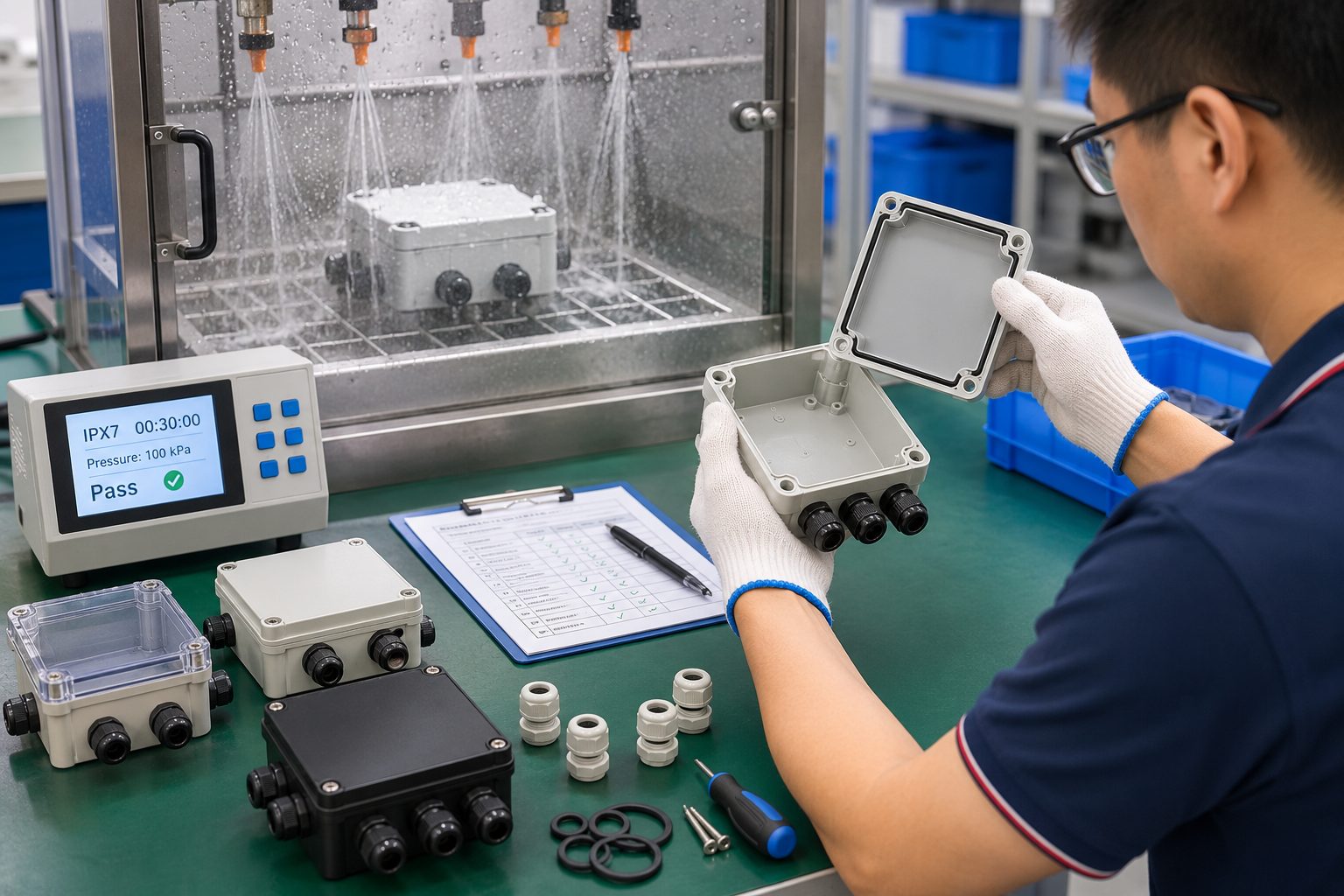
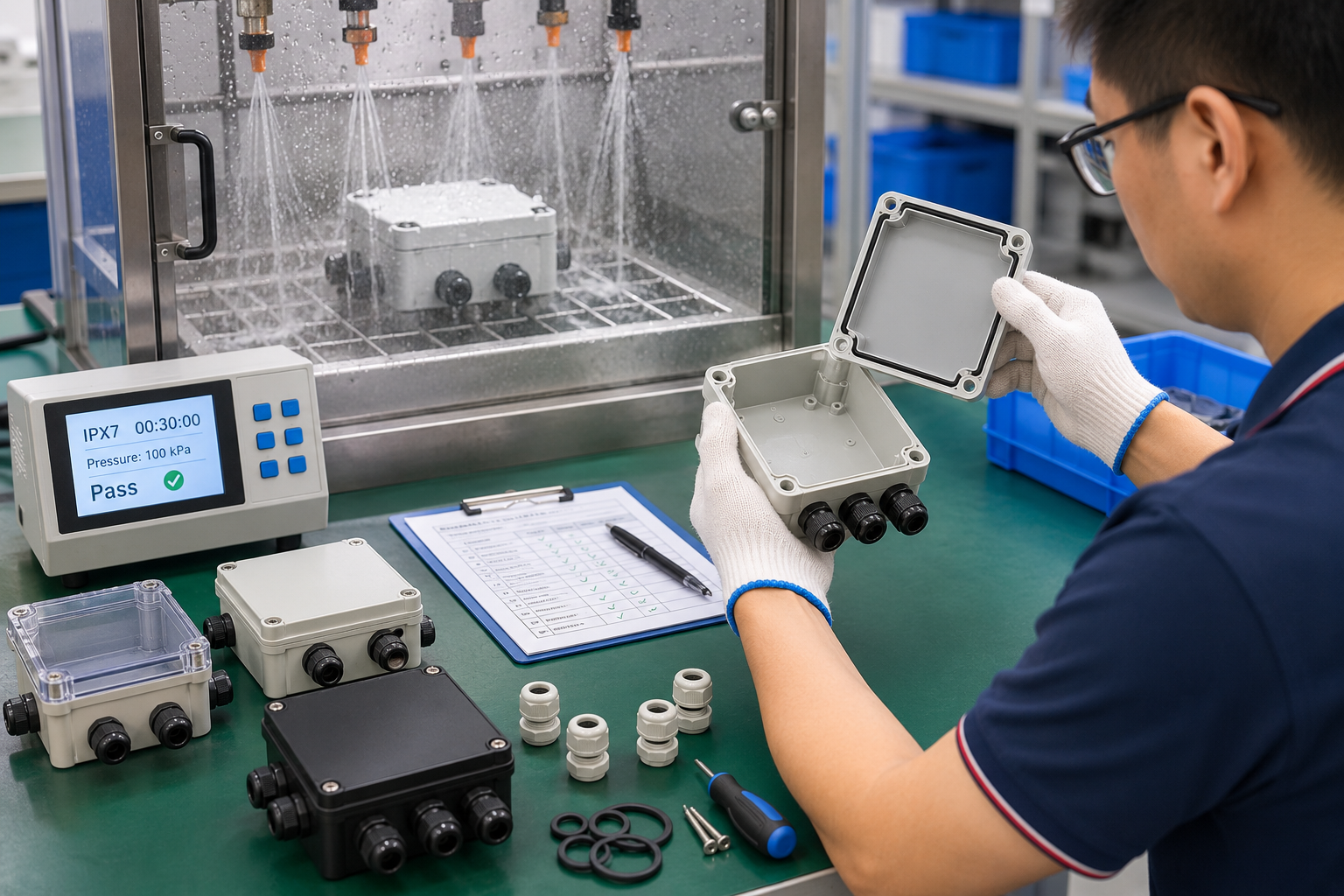
- Waterproof sealing inspection
- Packaging inspection
Customers evaluating a new supplier should also ask how production batches are managed, how dimensional consistency is maintained and what inspection procedures are performed before shipment.
More information about BOWO's manufacturing qualifications and certifications can be found on the Qualification page.
Section 08
Common Mistakes When Ordering OEM Waterproof Junction Boxes
Choosing the Lowest Price Instead of the Best Solution
The lowest quotation may not provide the best overall value. Material quality, machining accuracy, gasket performance and production consistency all affect the long-term reliability of the finished product.
Ignoring Future Maintenance
An enclosure should not only protect internal components but also allow technicians to perform routine maintenance efficiently. Hinged covers, transparent lids and properly positioned cable entries can significantly improve serviceability.
Providing Incomplete Technical Drawings
Missing dimensions or unclear hole locations often lead to repeated design revisions and longer development cycles.
Ordering Samples Without Defining Final Requirements
Before sample production begins, buyers should confirm enclosure dimensions, material, cable entry locations, color, accessories and branding requirements to reduce unnecessary modifications.
Section 09
How to Select the Right OEM Enclosure Manufacturer
Choosing an enclosure supplier is about more than comparing product catalogs. Long-term manufacturing capability and engineering support are equally important.
When evaluating potential suppliers, consider the following:
- Experience in OEM and ODM manufacturing
- Engineering support for customized projects
- Injection molding capability
- CNC machining services
- Stable production capacity
- Quality management system
- Export experience
- Responsive technical communication
Working with an experienced manufacturer helps reduce project risks while improving production efficiency throughout the product lifecycle.
Section 10
Frequently Asked Questions
Can I customize the enclosure size?
Yes. Depending on the project quantity, manufacturers may recommend modifying an existing enclosure or developing a completely new mold for unique dimensions.
Can you add cable gland holes before shipment?
Yes. CNC machining can be used to create cable entries, switch openings, display windows and connector cut-outs according to customer drawings.
Can I print my company logo on the enclosure?
Yes. Logo customization may include silk-screen printing, laser marking, UV printing or molded logos, depending on the project requirements.
Which material is better for outdoor applications?
Polycarbonate is generally preferred for long-term outdoor exposure because of its excellent impact strength and UV resistance. However, ABS remains an economical solution for many general industrial applications.
Can BOWO provide complete OEM support?
Yes. BOWO supports OEM and customized manufacturing, including enclosure modification, machining, branding, color customization and accessory installation for various electrical enclosure projects.
How can I request a quotation?
Providing enclosure dimensions, internal layout drawings, operating environment, annual quantity and customization requirements allows the engineering team to prepare a more accurate quotation.
Section 11
Conclusion
Custom waterproof junction boxes help manufacturers create products that are easier to assemble, more reliable in demanding environments and better aligned with their brand identity. Whether you require custom dimensions, cable entry machining, branded enclosures or complete OEM development, selecting the right manufacturing partner is essential for long-term product success.
Instead of adapting your equipment to fit a standard enclosure, OEM customization allows the enclosure to be designed around your product. This improves production efficiency, installation quality and overall customer satisfaction.
To learn more about BOWO's manufacturing capabilities, visit our About Us page or browse our complete range of waterproof electrical enclosure products.
Section 12
Start Your OEM Waterproof Enclosure Project
If you're developing a new electrical product or looking for a reliable OEM manufacturing partner, BOWO can help you customize waterproof junction boxes, electrical enclosures and distribution boxes based on your technical requirements.
Simply send us your drawings, enclosure dimensions, application details and estimated order quantity, and our engineering team will recommend the most suitable solution for your project.
Planning a project?
Share the application, installation environment and enclosure requirements with our engineering team.